by Editor | Oct 28, 2019 | Food, Products
By Elena del Valle
Photos by Gary Cox
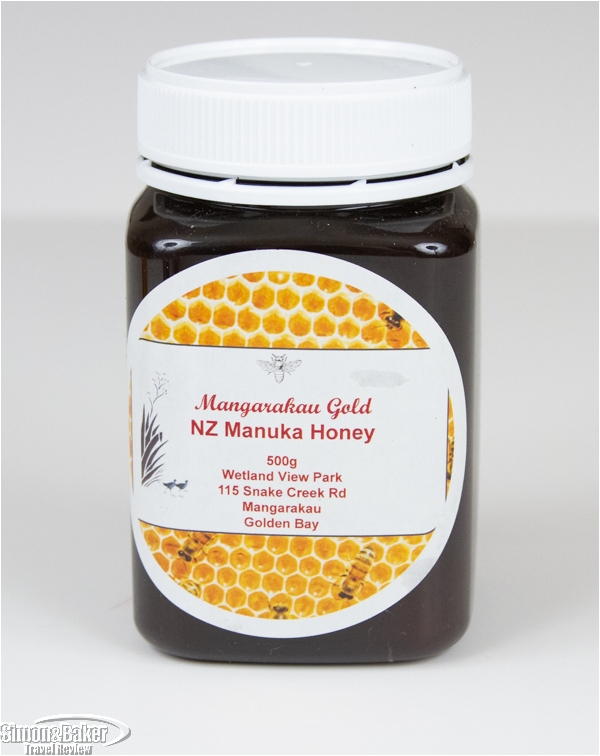
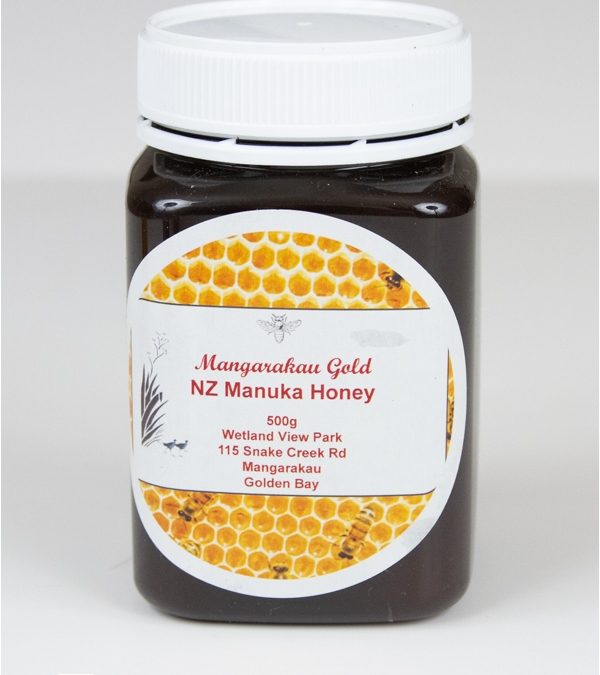
My favorite manuka honey was Mangarakau Gold from Westhaven Retreat
Soon after I arrived in the South Island of New Zealand for an Intrepid tour I sampled a spoonful of dark brown crusty honey with a hint of bitterness that captured my interest. It was an inconspicuous self sampling of Mangarakau Gold from an open container at the reception desk at Westhaven Retreat that made me stop and pay attention to New Zealand’s claim to honey fame, manuka. I bought a jar. I had passed by honey products advertised in many places in Christchurch before that. I have sampled many honeys over the years. This tasted special.
I bought a small jar of manuka honey at a health food store in Lyttleton near Christchurch in the South Island. The honey I bought at Westhaven, labeled Mangarakau Gold, is in a plastic jar. At 500 grams it is the largest of the three and my favorite despite (or perhaps because of) its hint of bitterness. The second honey, labeled Rochfort Downs, is in a 250 gram plastic container. Aotea, the store bought honey, is in an 80 gram glass jar. According to the label, it was processed by hand from hives on Aotea Great Barrier Island. It includes a batch number. There was no response to emails at the Aotea honey address. The Rochfort Downs and Aotea labels indicate they have 300+ MGO.
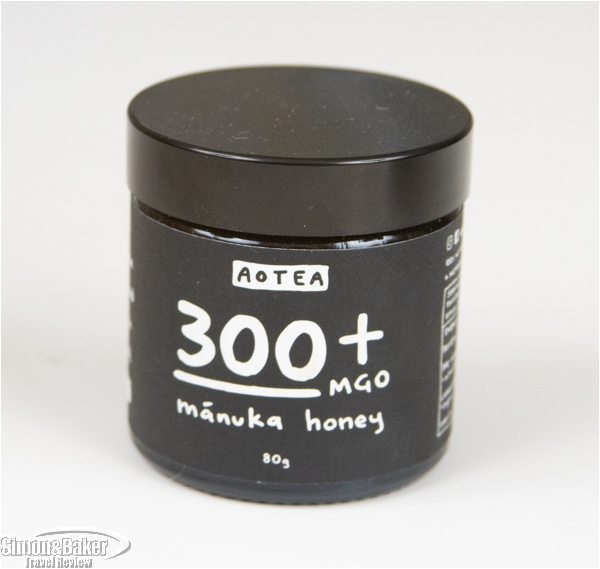
I bought a small jar of manuka honey at a health food store in Lyttleton.
Once home I tried the Westhaven honey as well as honey from Birds Ferry Lodge, clover honey from Cabot Lodge and the Aotea honey. Each one is distinct and slightly different from the others. This is especially the case with the Cathedral Peaks Honey, because it is clover rather than manuka honey, from Cabot Lodge. It was harvested by one of the owners on the 2,000 acre property. As their regular product was not ready for the public they kindly shared a 100 gram bottle (labeled Meant to B) from their recent wedding.
When I asked them about their honey they replied, “Brad’s family is heavily involved in agriculture and horticulture, his great grandfather was a prize ram breeder, his father is a large avocado and capsicum grower and his uncle is a beekeeper. For a while Brad left behind his agricultural roots to pursue a corporate career, but he always felt something was missing. One night he rolled over in bed and told me he wanted to become a beekeeper. I thought he was joking, as at that time we lived in the middle of Auckland City. He borrowed a few beehives from his father, and began to learn the art of beekeeping. Within six months he was determined to make it a career, and within 12 months we had packed our bags, moved to the other end of New Zealand to my parents farm, and Brad purchased 75 hives to begin his beekeeping dreams.”
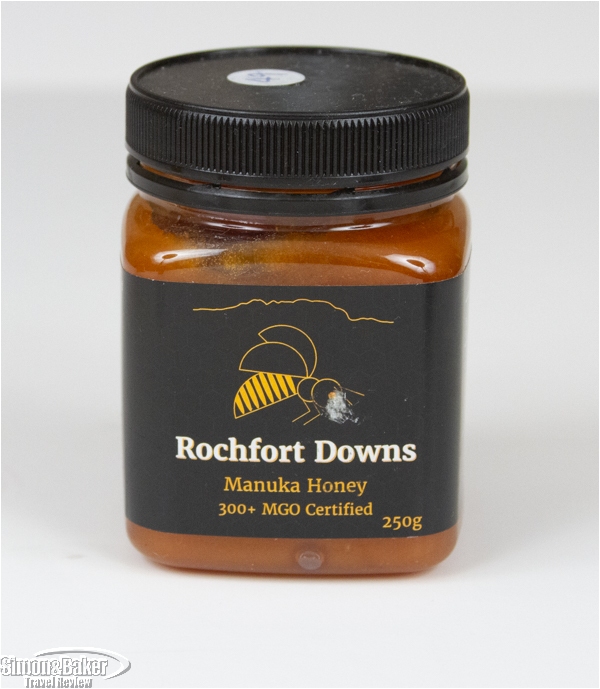
The Rochfort Downs honey in a 250 gram plastic container
Although I sampled the original manuka honey several times and the others I picked up on that trip I can’t put my finger on what it is that I like about them. In the end I decided to stop trying and savor the flavor along with the pleasant memories of my trip to New Zealand the honey evokes.
People I spoke with on my journey explained that manuka is known for its healing properties, wound healing in particular. Online resources tout its benefits for oral health, sore throat, digestive issues and other conditions (see 7 Health Benefits of Manuka Honey, Based on Science by Kaitlyn Berkheiser, a registered dietitian, published March 29, 2018 on Healthline.com) and a honey expert I spoke with support the concept.
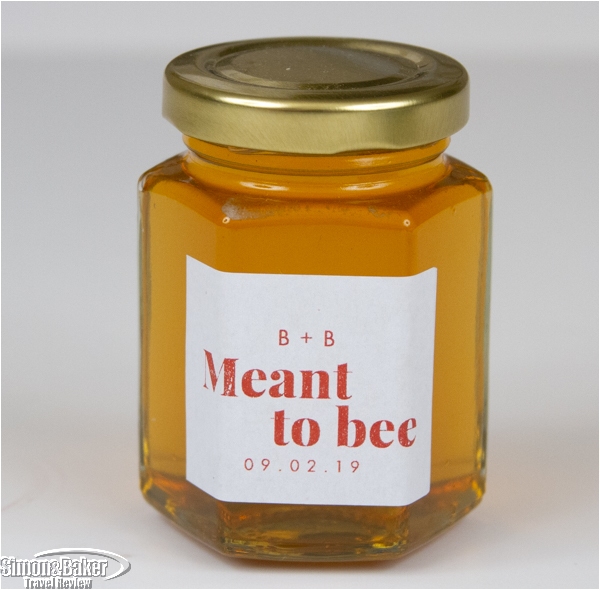
Clover honey from Cabot Lodge
While stateside honey is considered only a natural sweetener, not a drug, some believe honey, and manuka honey in particular, has healing properties. It has apparently been successfully used to treat wounds. Michele Colopy, program director, Pollinator Stewardship Council, an Akron, Ohio non profit organization, confirmed that credible sources describe manuka honey as having high concentrations of methylglyoxal (MGO), an antimicrobial and antibacterial naturally occurring substance described in the manuka honey bottles. Some believe that the higher the MGO concentration the greater the healing power of the honey.
She clarified that any honey, even those described as monofloral (made from a single type of flower such as orange blossom or lavender, for example), is the product of more than one type of flower. Bees get bored, and, it’s unhealthy for them to rely exclusively on a single plant source for nutrients, she explained by phone.
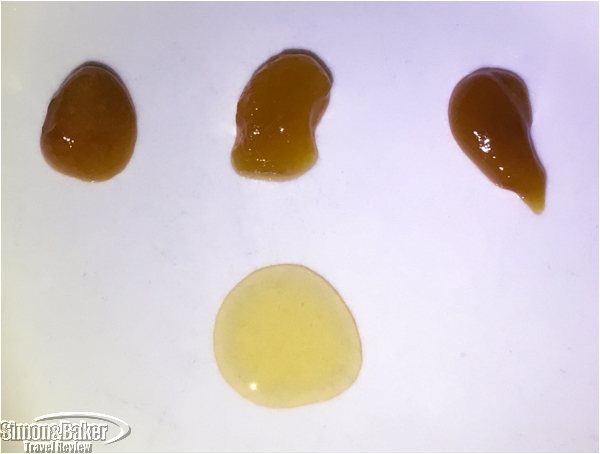
The thick and dark manuka honeys and the light colored clover honey
All four honeys I sampled where from small producers. Unless I return to New Zealand for another visit it will be difficult to buy more manuka honey from those small producers. The good news is that since my return home I have noticed many local stores have New Zealand manuka honey. Should I run out it will be easy to buy more even if it’s likely to be from large commercial producers. The honey I have left (more than I will eat in a year) will keep forever. Michele pointed out that honey never spoils. It would be possible to eat honey from the Egyptian tombs without any ills effects, she said. While I have no (immediate) plans to test honey from tombs for now I’m happy to occasionally enjoy a spoonful of thick liquid sweetness harvested by New Zealand honey bees. And if the honey includes healing benefits the better.
by Editor | Mar 4, 2019 | Food
By Elena del Valle
Photos by Gary Cox
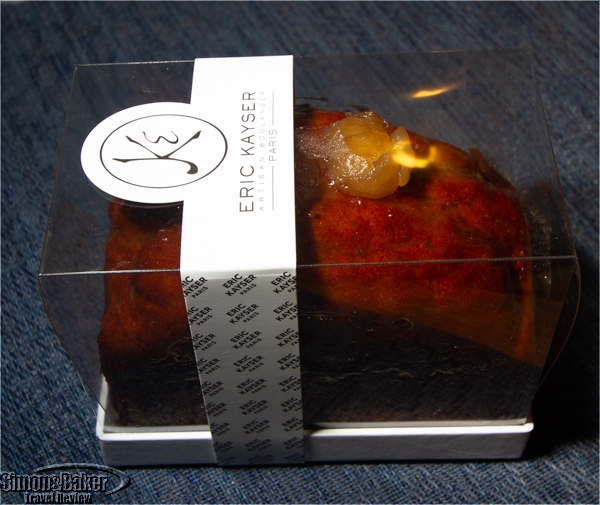
The seasonal holiday chestnut cake (not gluten free)
I have shopped in more bakeries in Paris, France than in any other city I have ever visited, but it wasn’t until my most recent stay that I noticed gluten-free products, mainly in restaurants and only a few. Eric Kayser (www.maison-kayser.com) bakeries stood out for their limited selection of gluten-free products. Having been to a handful of the company’s 240 bakeries in 27 countries and liked some of their products I wondered what the gluten-free line would be like.
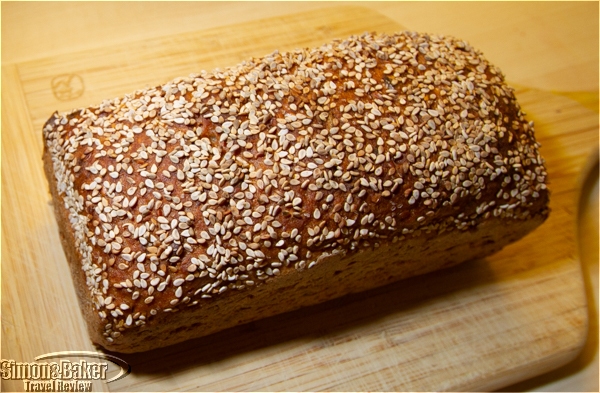
The gluten free bread had sesame seeds on top and other seeds inside.
We sampled three gluten-free items and several regular products at home, most from two locations on the rue Monge (14 rue monge, 8 rue monge) near the boulevard Saint Germain on the Left Bank. We liked all three of the gluten-free products: two loaves and one moist chocolate brownie cookie. They were Pain Mendiant San Gluten made with rice and buckwheat flour, apricots, raisins and apples (550 grams); Pain Aux Cereals San Gluten with sunflower and sesame seeds (600 grams); and Indecent Au Chocolat (90 grams). From the other products we liked the following especially: seasonal holiday chestnut cake, sesame seed and poppy seed baguette (by special order), and chocolate financier with chocolate chips.
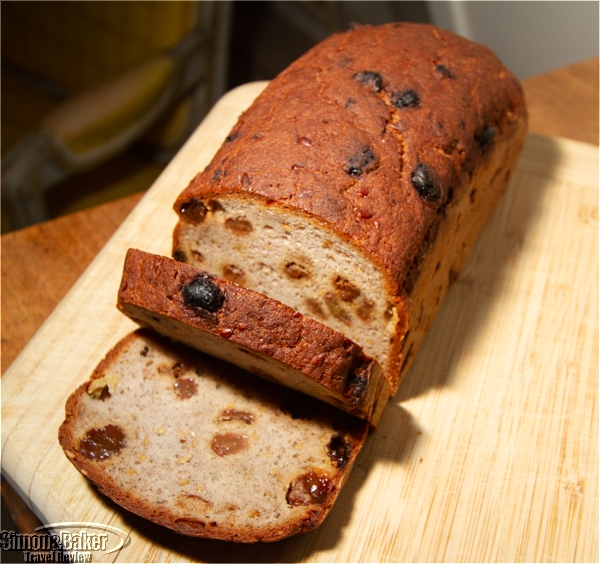
The gluten free date and raisin loaf was a good match with foie gras pate
The gluten-free products were baked from 100 percent fresh ingredients at a dedicated location elsewhere in Paris (not where we picked them up). The ingredients were 90 percent organic for bread and 40 percent organic for gluten-free pastries, according to a company spokesperson.
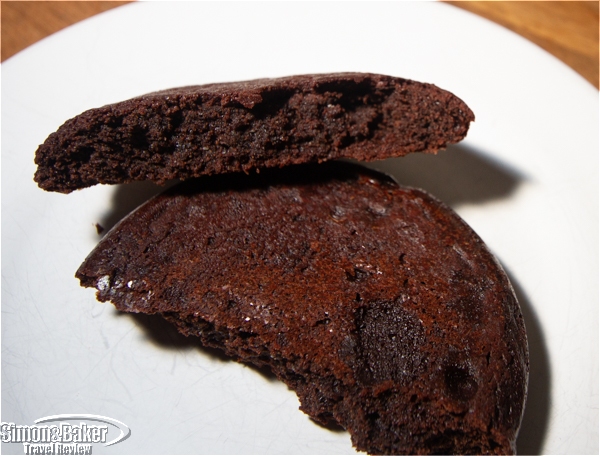
The gluten free chocolate cookie was moist and chewy and had a rich chocolate flavor.
In addition to the flavor and texture we liked that the gluten-free loaves kept fresh for several days in contrast to regular baguettes, which generally go stale within a day. We enjoyed the fruit and nut loaf with duck foie gras and seeded loaf slices made a good base for avocado toasts. The chocolate brownie cookie was moist and had a deep rich chocolate flavor.
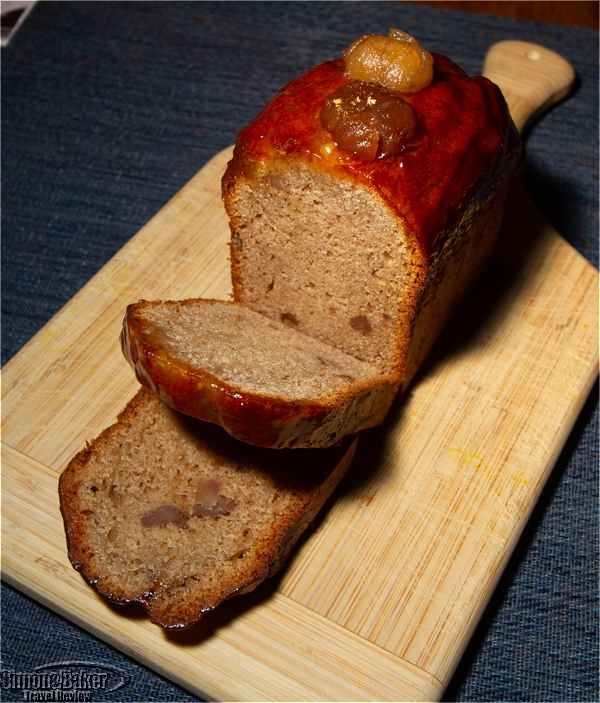
The seasonal chestnut cake, coated with a lightly sweet syrup, was moist like a rich pound cake
The chestnut cake kept fresh for several days and was a good accompaniment to coffee. We also paired it with loose leaf fragrant vanilla red tea at any hour of the day. It was important to wrap it in a plastic bag to keep it from drying out.
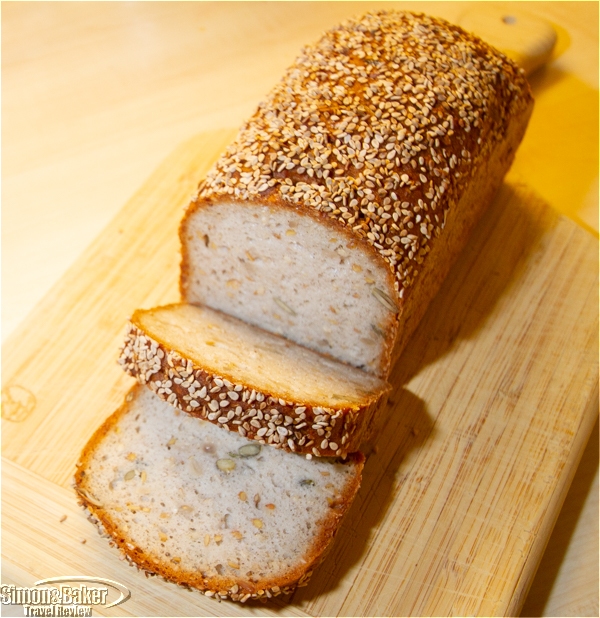
The gluten free bread was a good base for avocado toast
Staff were friendly and helpful at two of the three locations we visited. They were friendly and spoke English of their own accord when they heard us speaking English at the shop on the popular rue de Montorgueil on the Right Bank. Product information on the wrappers was listed in French and English. Kayser was a native of Alsace and the grandson and great-grandson of bakers. He owned most of the chain’s shops with the exception of those at train stations and airports.
by Editor | Dec 3, 2018 | Food
By Elena del Valle
Photos by Gary Cox
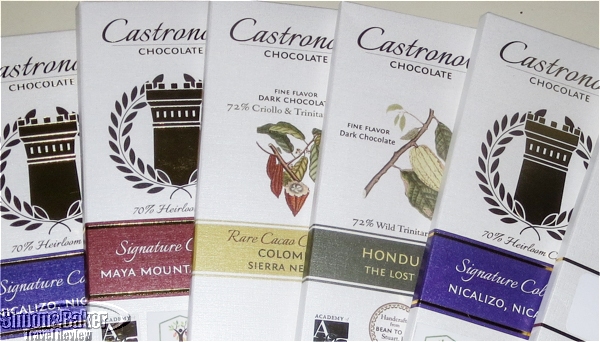
Castronovo bean to bar chocolates from individual countries
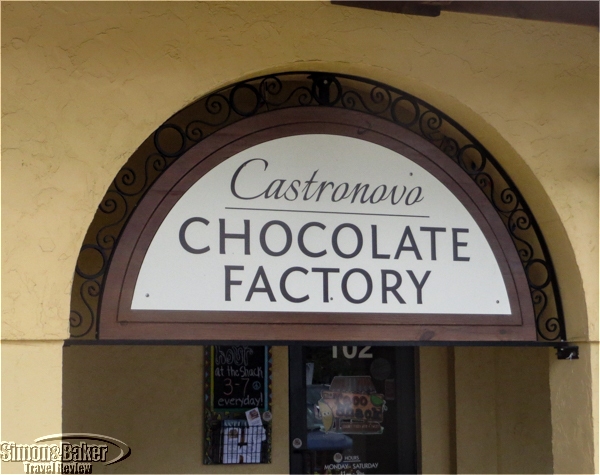
The Castronovo Chocolate Factory in Stuart, Florida
I had sampled Castronovo small batch craft chocolate several times before I made it to the 725 square foot shop and factory in Stuart, Florida. The rich dark chocolate 2.2 ounce single origin bars had made a fan out of me. I liked their distinctive yet nuanced flavors of the dark chocolate bars and that they were made with only three ingredients: cocoa beans, organic cane sugar, and cocoa butter.
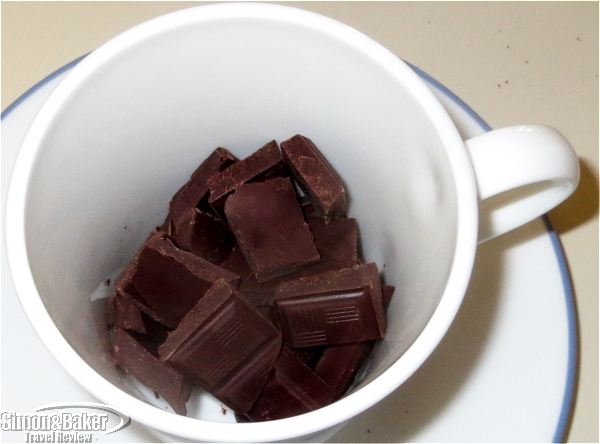
Pieces of a Castronovo bar ready for hot water
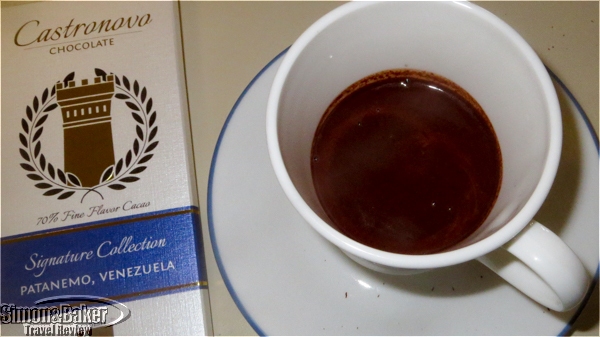
The Patanemo, Venezuela dark chocolate melted in a small amount of water tasted fantastic
Whether it was in a hot chocolate beverage or in morsels the chocolates I tried were head and shoulders above the supermarket bars and some gourmet bars. The day of our visit we tasted the 70 percent Hurricane Relief Benefit Bar from Hacienda Jeanmarie from Puerto Rico and ordered two batches of fresh baked chocolate chip cookies. The bar was inside a sealed foil envelope with a paper wrapper. Handwritten on the back was the batch number and the expiration date more than a year later.
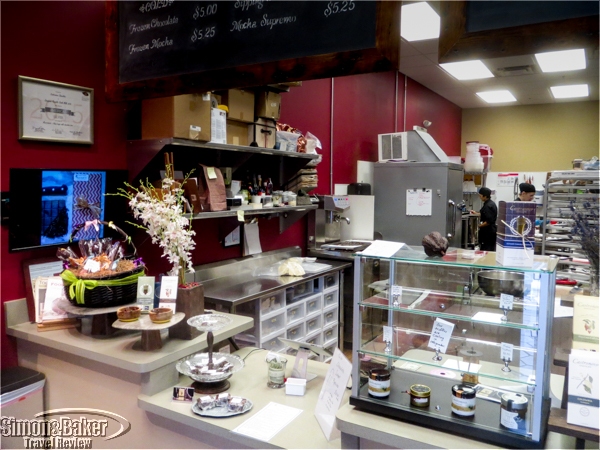
The shop doubled as a chocolate factory
I later found out the shop carried chocolate from eight vendors in Belize, Nicaragua, Colombia, Venezuela, Honduras. Because organic certification is expensive for farmers to obtain, the shop only sold two origins certified organic, Belize and Honduras, the owner explained by email.
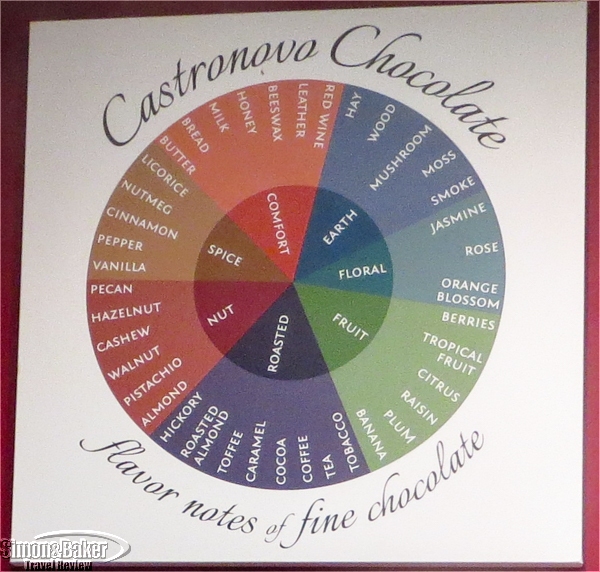
A sign on the wall at the shop
“We are very selective in choosing our producers,” Denise Castronovo said by email when asked about the selection criteria for her factory. “First off, the cocoa beans need to be produced using fair labor practices. Usually the beans come from family farms or indigenous communities. Since cacao is an understory shade crop, we seek out producers who typically are gathering the cacao in a rainforest environment rather than from plantations. Many of our cocoa beans are grown in the wild and simply harvested. Finally, when all of these criteria are met, we consider the flavor profile and looks for fine flavors that are unique to our line of chocolate and are not flawed by any errors in the fermentation.”
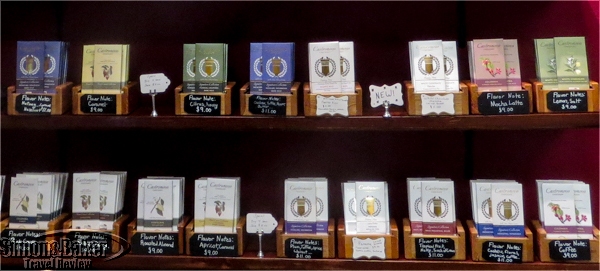
Each bar was on display with a handwritten description of its most distinctive flavor notes.
When asked how she chooses new suppliers she replied, “We require that our new suppliers be transparent about their sourcing to ensure that the farmers are paid fair wages. We work closely with suppliers who provide technical expertise on the post-processing fermentation and drying to ensure that the bean quality develops fine flavors and consistency. We purchase our cacao through direct trade which means that the cacao is not sold on the commodity market and there is price transparency throughout the supply chain to ensure that farmers receive a fair wage.”
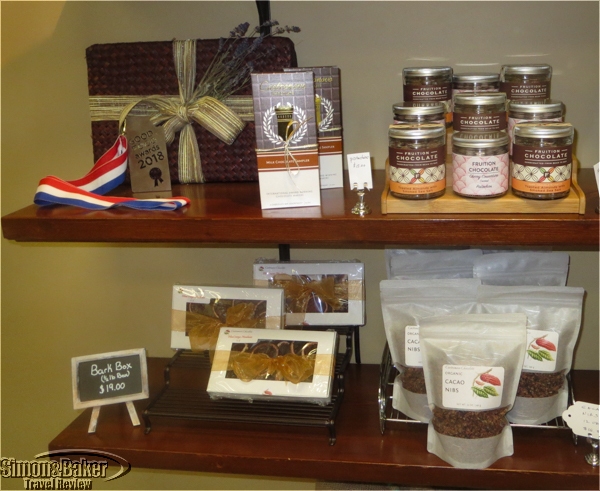
Chocolate products for sale at the shop
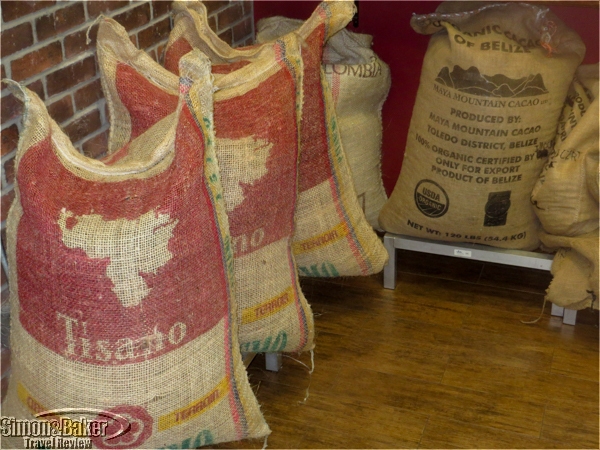
The original cocoa bags were on display, waiting to be processed.
It was too early for the cookies, making it necessary to pay for them and return an hour later when they were cool enough to pack. The staff member who looked after us, a vivacious and enthusiastic woman, was friendly and service oriented. She answered our questions and made suggestions when asked. With her assistance I bought other single origin bars, which I have yet to open. When I wondered about specifics regarding varietals she found a colleague to answer my questions. On the way home we ate most of the Puerto Rico bar, savoring the unctuous chocolate with hints of raisin flavor.
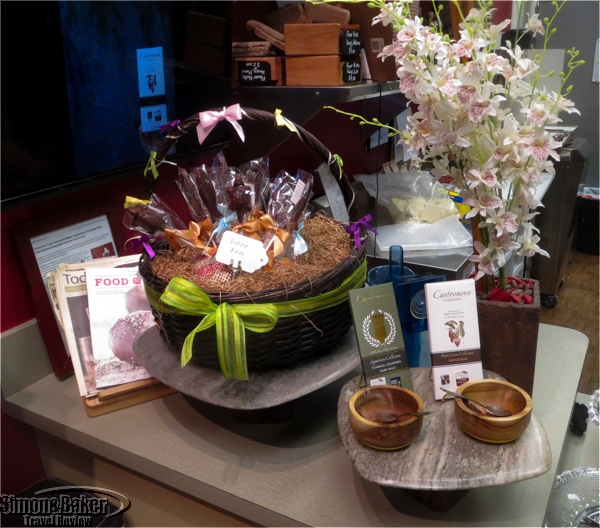
There were samples on the counter.
When asked about staff training Castronovo explained that she instructs hires in factory methods of chocolate making, food safety, chocolatier work, pastry, barista, customer service and education. Over the years, the shop has had staff with professional pastry chef training, which was helpful for new product development.
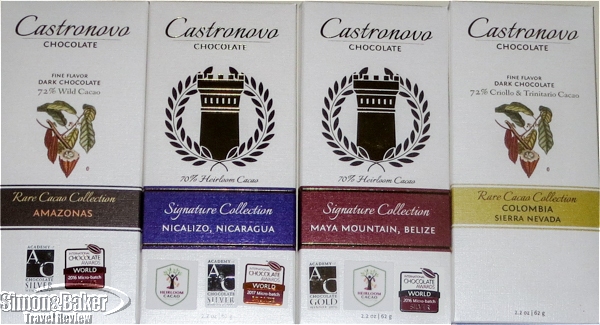
Many of the bars featured awards and certifications on the labels
I have heard some chocolate fans wax poetic about the pedigree of their bean varietal as well as single source origin. When purchasing raw ingredients Castronovo focuses her energy elsewhere, she explained.
“The bean varietal (criollo, trinitario, forester) is not the most important factor – taste is far more important,” she said. “We do seek out heirloom varieties of cacao, whenever possible, so we can preserve the native cacao varieties from a region and discourage plantings of genetic hybrids. There are some genetic hybrids of cacao that we stay away from because they were modified for high production rather than fine flavor and taste terrible.”
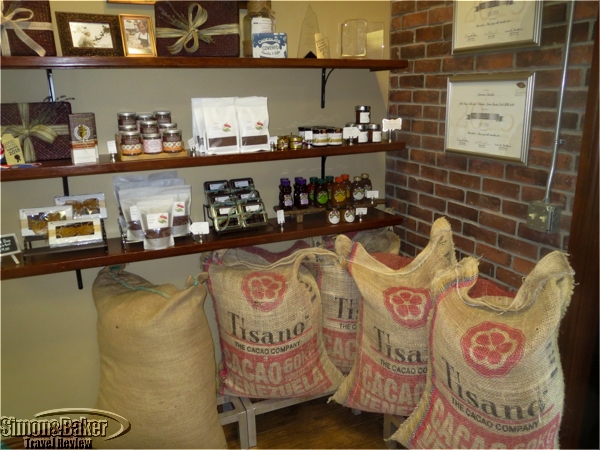
Products for sale and cacao bags inside the shop
She believes in bean to bar single origin production. In that regard she said, “We create small-batch single origin chocolate, so the origin is extremely important. At each origin there are unique cacao genetics and terroir which create different flavors in the final product.”
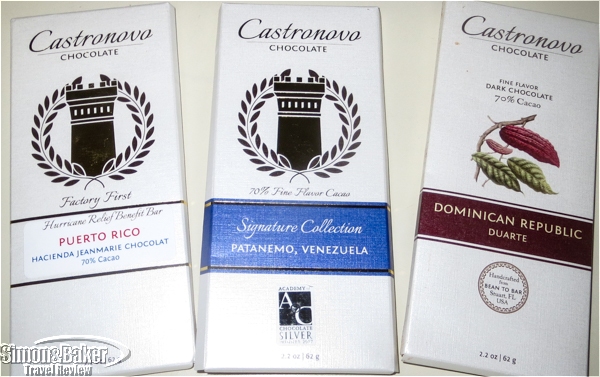
Some of the Castronovo chocolates, including, in the middle, one of our favorite bars
We liked the 70 percent bar from the shop’s Signature Collection, a single origin from Patanemo, Venezuela. We repeated the hot chocolate beverage tasting with Castronovo Chocolate Factory (555 S. Colorado Ave #103, Stuart, Florida 34994, +1 772-521-1699, www.castronovochocolate.com, castronovo@outlook.com) bought chocolate with equally rewarding results. The dark chocolate was a 70 percent cacao from Duarte in the Dominican Republic (no longer available). We also liked the Patanemo Dark Milk 66 percent and Nicalizo, Nicaragua 70 percent bars from the Signature Collection. I look forward to more Castronovo dark chocolate bar tastings in the coming months.
by Editor | Sep 11, 2018 | Food, Products
By Elena del Valle
Photos by Gary Cox
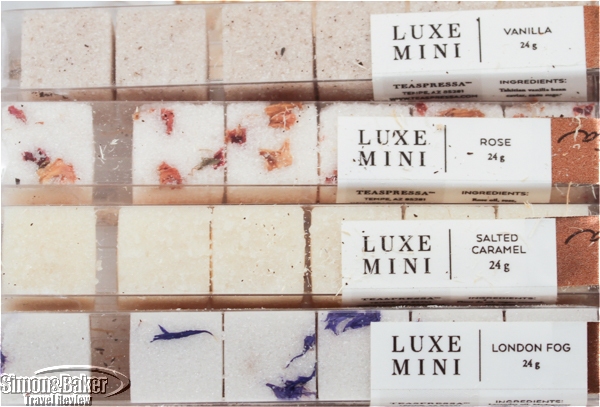
Flavored sugar cubes from the Teaspressa Starter Kit
Years ago in a small cafe in Stellenbosch, South Africa I had a memorable red tea made like an espresso. The resulting beverage was concentrated and small with the rich flavor of South African red tea. Recently, an at home tasting of four loose leaf teas from the Teaspressa Starter Kit reminded me of that delicious beverage. Teaspressa (Arcadia Signature Cafe, 4628 E Indian School Road, Phoenix, Arizona 85018, +1 917-710-5748, www.teaspresssa.com, info@teaspressa.com) is a new Arizona company founded by Allison DeVane. She created Teaspressa’s proprietary Tea Concentration Technology that uses a pressure extraction method to produce tea blends that, like espresso, can be used to make Tea Lattes, tea-based drinks comparable to gourmet coffee beverages.
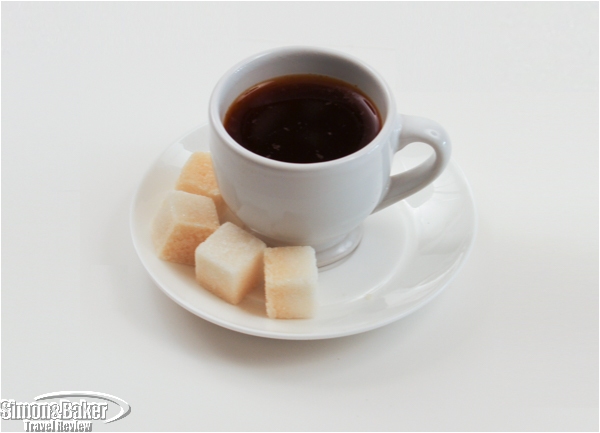
A tea shot and flavored sugar cubes
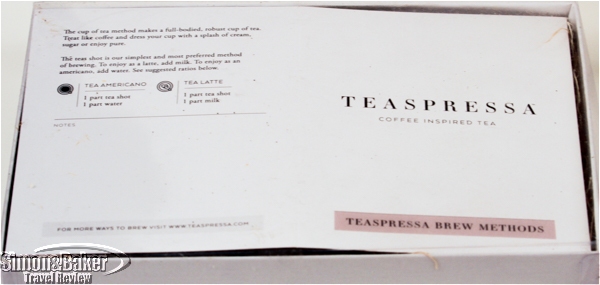
Our Starter Kit arrived in the mail with a black espresso pot, four teas, and four packages of flavored sugar cubes.
”Teaspressa is the first and only beverage that is a hybrid of tea and coffee, resulting in a healthy alternative to traditional caffeine drinks,” DeVane, who is also owner of the company, said by email via her publicist when asked what is special about her company’s teas. “Using a patented production process, Teaspressa is concentrated tea that contains as much caffeine as an espresso shot, but provides consumers the health benefits of traditional tea blends.
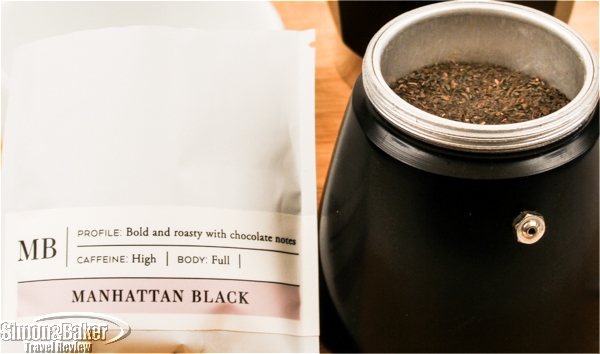
Manhattan Black, one of four teas in the Starter Kit.
Teaspressa is made similar to a shot of espresso, and has the same amount of caffeine; however, Teaspressa does not contain coffee, it is a concentrated tea that is made using a pressure extraction method, resulting in Teaspressa’s products containing all of the health benefits found in traditional tea. Just like espresso, Teaspressa can mixed with milk and more to create lattes and other gourmet coffee-like beverages, but with tea. Teaspressa can be made at home easily and similarly to traditional coffee, so consumers don’t lose their morning coffee ritual.”
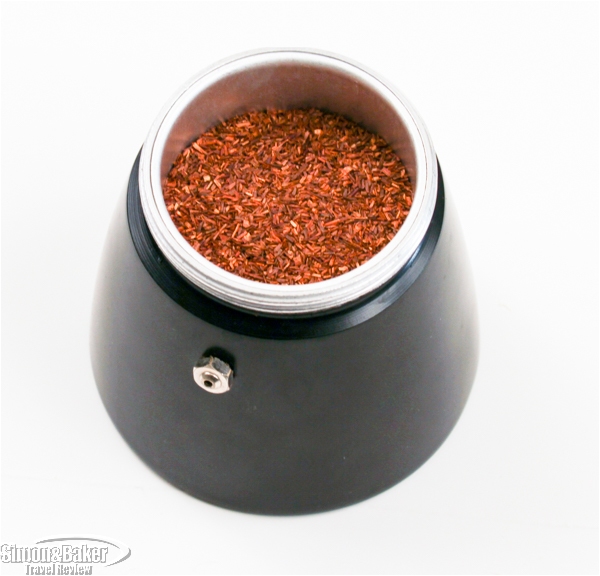
Red tea, naturally free of stimulants, in the espresso pot before brewing
Our Starter Kit arrived in the mail with a black espresso pot, four bags with several servings of tea each, and four packages of flavored sugar cubes. The teas, blended in Phoenix, were Manhattan Black, proprietary black tea and German rye; Cape Town, naturally caffeine-free rooibos and rye; Green Gold, proprietary green tea blend; and Charles Grey. There were four Luxe Sugar Stick flavors, handcrafted by Teaspressa using all-natural ingredients: London Fog, Rose (recommended by DeVane with champagne), Salted Caramel and Vanilla.
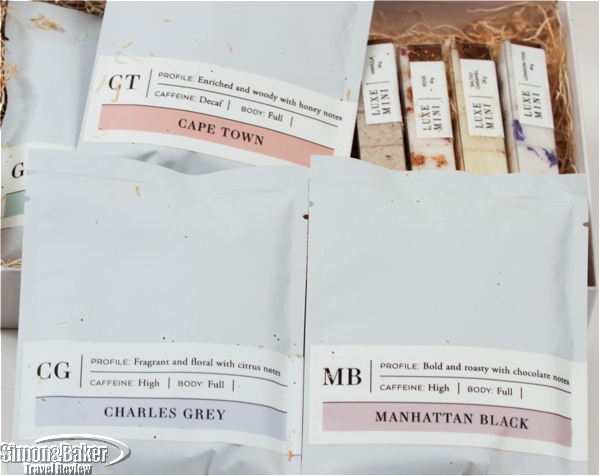
The teas, blended in Phoenix, were Manhattan Black, Cape Town, Green Gold, and Charles Grey.
According to DeVane, Teaspressa’s products are certified organic by the United States Department of Agriculture and made from “all natural, artisan loose-leaf tea blends, authentically sourced from China, Germany, South Africa, India and Japan.” She explained that the signature tea blends “underwent multiple phases of testing and are specialty curated for the brewing method that is similar to coffee brewing.”
Three of us, all tea fans, sampled and liked the teas and their concentrated flavor. We made them using the espresso pot per the instructions that came with the package. While none of us sweetens our tea we tried the sugar cubes, each less than 10 calories per cube and made with sugar from Hawaii, according to DeVane, on their own and also liked them. My favorites were London Fog and Rose in that order. The two men preferred Salted Caramel and Vanilla.
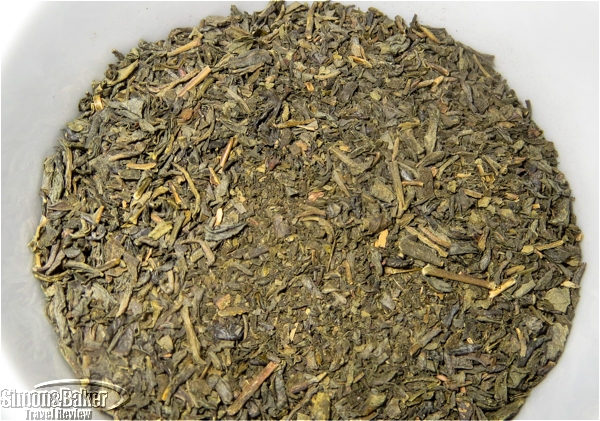
The Green Gold
The Teaspressa tea shots were especially appealing when time was limited such as at the end of a meal and when in the company of espresso drinkers. In lieu of the longer time it takes to savor and drink a cup of tea or a pot of tea sometimes it would be nice to have a tea shot. The teas were available via the company website as well as at Teaspressa Ann Arbor Signature Cafe (414 S Main St #115b, Ann Arbor, Michigan 48104) and Teaspressa Frank Lloyd Wright Kiosk (12621 N Frank Lloyd Wright Blvd, Scottsdale, Arizona 85259).
by Editor | Mar 27, 2018 | Food
Article by Margot Liebman
Photos by Aaron Lubarsky*
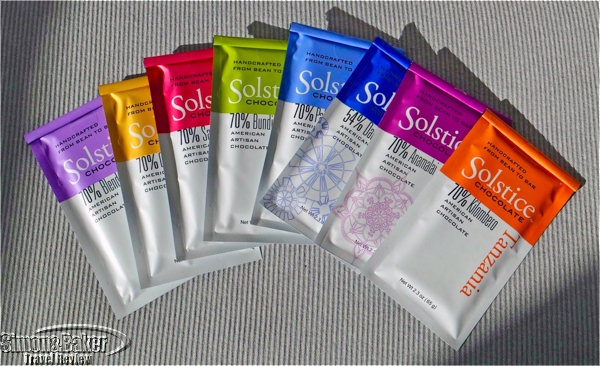
The selection of Solstice bars I tasted.
When a small box appeared in the mail one afternoon in late December, I was pleasantly surprised. Inside were eight sleek bars of chocolate from Solstice Chocolate, a premier American artisan chocolate maker in Salt Lake City, Utah (Solstice Chocolate, Inc., 469 West Century Drive, Salt Lake City, Utah 84123, +1- 801-871-5935, www.solsticechocolate.com, info@solsticechocolate.com). Each bar was dressed in a smooth, thick paper and foil package that resealed at the top to keep the chocolate inside fresh; and color coded with bold type indicating its origin, cacao percentage, and brand name.
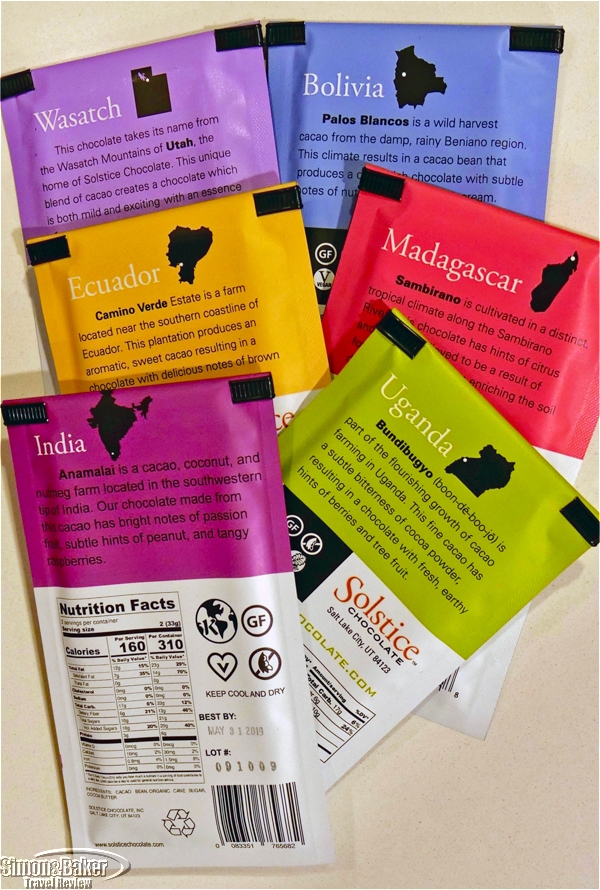
The packaging described the source of the cacao beans used to make it.
The Solstice website, describes its products as a “bean-to-bar chocolate” that is handcrafted using the finest single origin cacao from all over the world. With names like India, Madagascar, and Tanzania, it was easy to know where a bar’s beans originated. I imagined that each bar would taste quite different, but quickly learned that the differences were subtle. From bean delivery to getting packaged bars out the door Solstice allotted between seven and ten days for production.
“Our chocolate is known for having bright flavors. Our origin varieties range from fruity to earthy; there’s something for everyone,” said DeAnn Wallin, owner, Solstice Chocolate when asked by email what distinguishes Solstice products from those of other chocolate makers. “Our bars stand out, each having its own personality, so to speak, and each can be distinguished from the others. Our style is also reflected through uncluttered packaging with bold colors.”
As a milk chocolate lover, it took me a while to appreciate the dark, intense flavor of the Solstice Chocolates. Most of the bars tasted earthy and bitter, and were almost waxy in consistency. Save the one bar of milk chocolate, all the bars boasted 70 percent cacao. That said, it was fascinating to savor the different notes in each bar, and to think about the harvesting conditions that must play a role in how the beans grow.
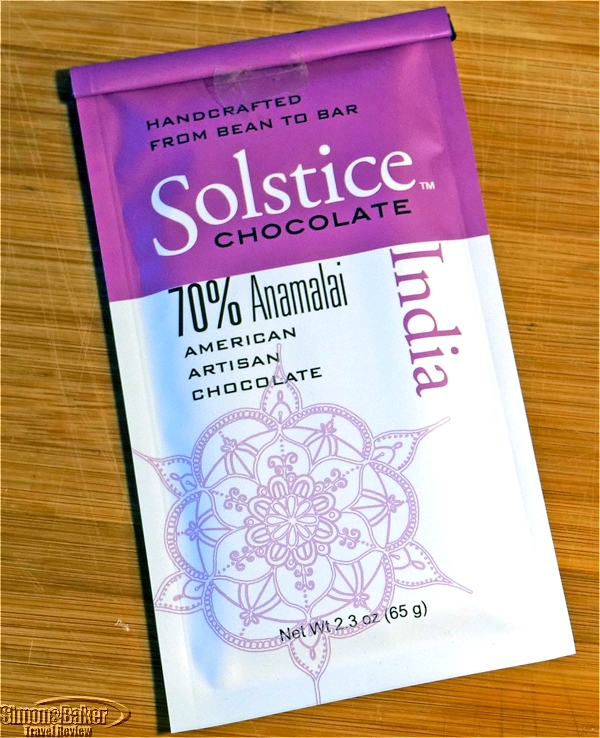
The bars displayed the percentage of cocoa.
I first tasted Uganda, which had a bitter tone that left hints of berries on my palette. Second I sampled Ecuador. When I looked on the Solstice website, I saw that Ecuador was handcrafted from cacao grown by Camino Verde Estate, a farm located near the southern coastline of Ecuador with an unusual fermentation method. It was a strong flavor, with sweet aromatics and hints of banana and cream. The next one was Bolivia. At first bite, a wave of nostalgia rushed over me. I quickly realized the bar reminded me of baking chocolate. It tasted of honey, nuts, and favorite memories of making chocolate desserts.
When asked how her company selects the beans Wallin replied, “Networking through trusted sources. We receive cacao samples on a regular basis. If one interests us then we test it, research it and decide if we want to invest in using it.”
Tanzania was fruitier, smoother and a bit more tart than the previous bars. Wasatch was exciting, and had an unexpected spiciness. India was more complex than some of the others, with tangy flavor notes and hints of earthy spice. Madagascar was more of a slow experience, as most of the flavors came to me a few moments after the piece had already melted on my tongue. There was a strong citrus tone, and when I looked at the Solstice website I learned that those flavors are believed to be a result of former fruit plantations enriching the soil during French Colonial times.
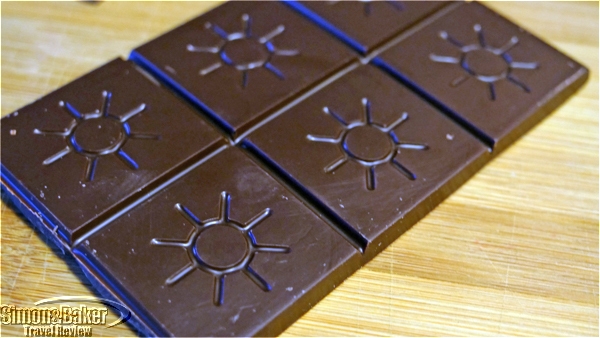
The bars were molded with a sunburst shape in the center of each square.
For my last delicious morsel, I saved the milk chocolate. The package indicated that the bar was 54 percent cacao, where the dark chocolates were 70 percent cacao. The flavor was denser, and not as milky in texture as other milk chocolates I have sampled. I tasted subtle hints of graham cracker, but that may have been wishful thinking for a s’more.
Solstice Chocolate bars were lovely to look at. The packaging employed a celebratory color palette, and each bar was clearly labeled. A white dot on the country of origin map on the back of the package indicated where the beans were farmed. Knowing where the beans were sourced helped me enjoy the chocolate bars in a different way. I found myself looking for subtleties and thinking about the story of each chocolate in an interesting way. Based on my experience, I would recommend Solstice Chocolate to my friends who like dark chocolate.
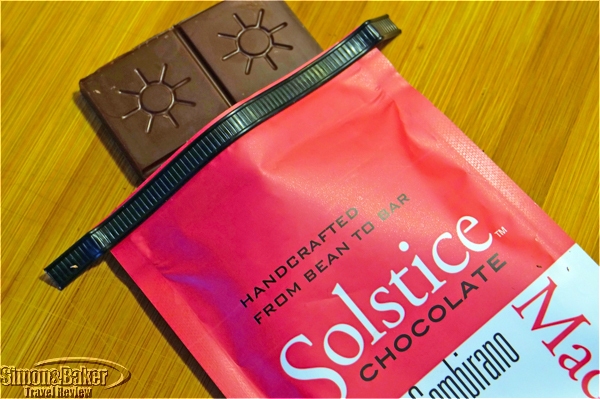
The packaging included a closure to reseal it after opening.
Editor’s note: We asked two of our contributors who are dark chocolate lovers to sample Solstice chocolates in February 2018 as well. Here is what they found.
We compared the Solstice Chocolate Madagascar 70 percent Sambirano, a 2.3 ounce bar, with a well-known premium European dark chocolate bar with a similar cacao content and were stunned by the difference in the two. We blended each with hot water and tasted them side by side. Where the hot drink made from the European bar was almost lumpy in texture, had a milky undertone and muted flat flavor the Solstice hot drink was smooth in texture and taste, with a layered tart flavor that was rich with just a hint of pleasant bitterness. It remains memorable after several weeks.
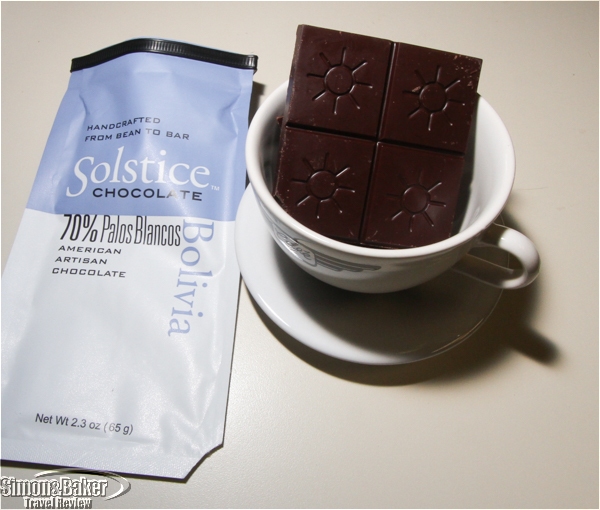
Melting the chocolate into a couple of ounces of hot water created a delectable drink.
We also liked the Bolivia 70 percent Palos Blancos, which came in a 2.3 ounce bar. For a contrast we also sampled the Solstice Chocolate Coconut American Artisan White Chocolate, a 2.2 ounce bar. The coconut burst through immediately past the sweet and buttery texture of the butter colored pieces to become an instant favorite.
We appreciated the simplicity of the ingredients. The Sambirano and Palos Blancos ingredients were organic cacao bean, organic cane sugar and organic cocoa butter. The white chocolate was made with cocoa butter, whole milk, organic coconut, organic cane sugar, and pure vanilla extract.
*The final photo is by Gary Cox.
by Editor | Dec 14, 2017 | Food
Article by Margot Liebman
Photos by Aaron Lubarsky
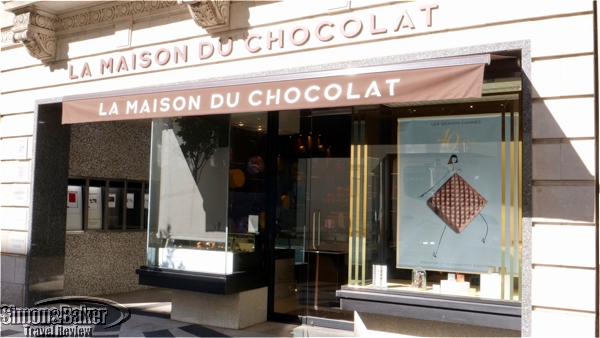
La Maison du Chocolat Madison Avenue store
We thought we knew chocolate until we tasted some of the products of La Maison du Chocolat (1018 Madison Avenue, New York, NY 10075, http://www.lamaisonduchocolat.us/la-maison/en_us, +1 718 361-9161), a French company. At the time of our tasting, in addition to locations in France and several in New York City, the company had shops in China, Japan, Korea, Kuwait, Macau, and United Kingdom.
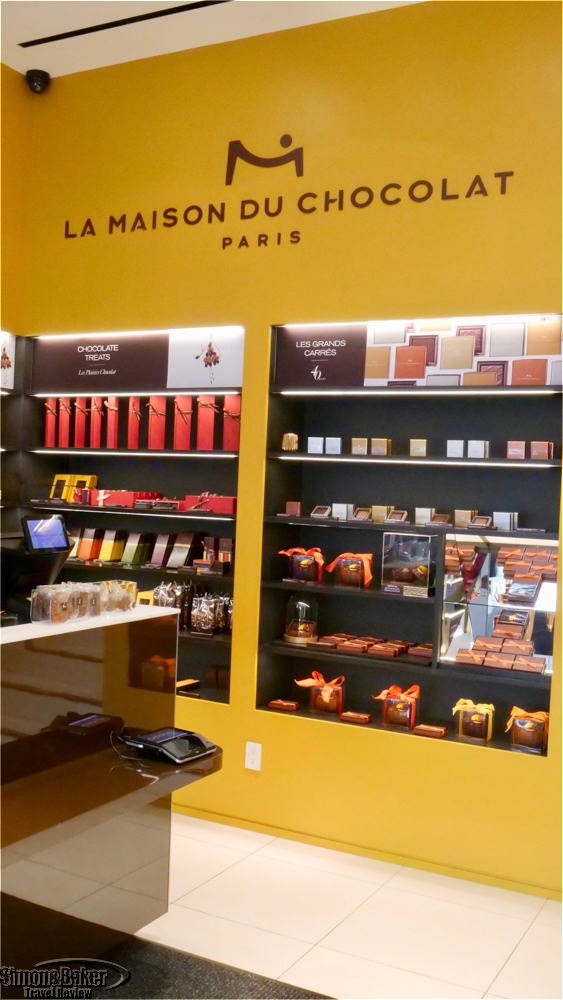
Inside the Madison Avenue store
We arrived on a cool, sunny morning in mid-October as the Madison Avenue store was opening. The city was just waking up, with people on their way to work and the streets starting to fill with the daily bustle. Located in an upscale neighborhood, La Maison du Chocolat’s boutique shared a block with prestigious clothing stores and cafes. During our visit, we each tasted six chocolate truffles, one macaron and two types of hot chocolate. We returned home with a box of six macarons (meringue and almond flour confections).
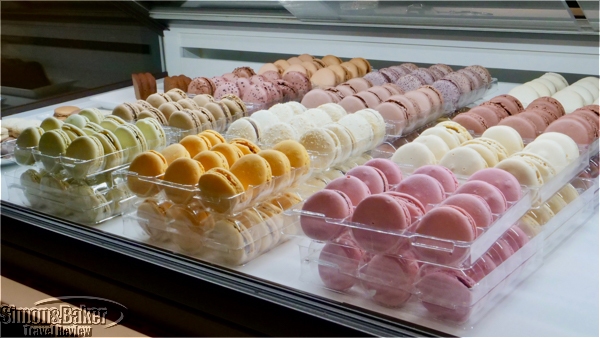
Macarons on display
At the front of the store shelves displayed various chocolate collections in signature dark brown boxes. There was also a counter with individual chocolates, as well as fresh pastries laid out in the window. The shelved collections of chocolate were organized by individual lines, including: Truffles, Maison Icons, Pralines, Chef’s Creation, Grand Carrés, Chocolate Treats, and the 40th Anniversary line. One of the friendly staff explained that the Maison Icons are the best selling line because they are the most well known, and come in boxes that may be customized.
The shop had the understated aesthetic we expected from a chocolatier: dark brown boxes, neatly organized chocolate truffles on display, and minimal decorations on the walls. In the back of the store there was a small café where we sampled six square chocolate truffles arranged in order of darkness. I started with Akosomno, the darkest chocolate. It was deep and smooth, and revealed an unexpected spicy note at the end. Next was Caracas, a bolder experience and by far the most intense. Boheme, the third on the plate, was the perfect harmony between milk chocolate and dark, the two notes came in and out as it melted on my tongue. I normally do not favor chocolate mixed with fruit, but Salvador was an exception. The dark chocolate mixed with an acidic raspberry ganache (a filling made from chocolate and cream) was tangy and exciting. Crystal touched all the notes evenly for a perfect flavor: it was a delicate blend of crispy, sweet, nutty praline wrapped in silky milk chocolate, finished with a touch of sea salt. Lastly, Grain Dentelle’s milk chocolate blended caramelized nuts and crispy pieces of crepes for a subtle, crunchy texture.
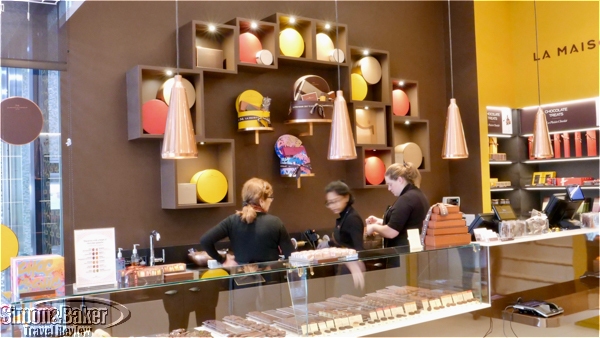
Busy staff behind the counter
It was early in the morning when we tasted the truffles, so we tried to restrain ourselves. We were unsuccessful. The chocolates were so rich and delicious, we ate most of what was on our plates.
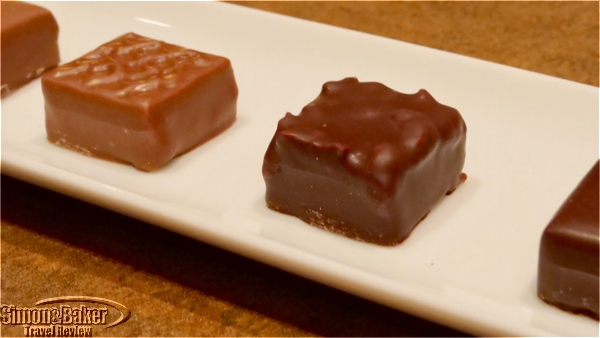
We sampled six chocolate truffles
We tried two types of hot chocolate. Guayaquil was like the luxury version of my childhood hot chocolate. It was creamy and sweet, but grounded by the gravitas of fine chocolate. Caracas was an unexpected experience for me. It had a full-bodied flavor with a light texture.
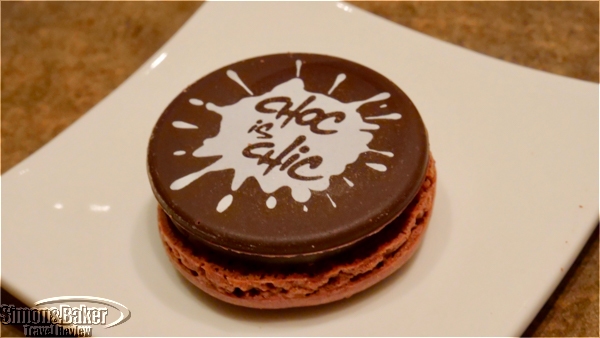
La Maison du Chocolat’s 40th anniversary limited edition macaron
We also sampled a La Maison du Chocolat’s 40th anniversary limited edition macaron, which was filled with dark unctuous ganache and subtle passion fruit within a thin and crunchy chocolate disk and soft, chewy cookie.

In the cafe in the back of the store we sampled six chocolate truffles arranged in order of darkness
As we indulged in the tasting, the staff recounted the story of La Maison du Chocolat, and the reasons they believe their chocolate is so special. Rami Sarabi, country manager, told us that ganache is the secret. Robert Linxe, who founded La Maison in 1977, was known as the “Sorcerer of Ganache.” Linxe insisted on making chocolate the old-fashioned way, which takes three days, according to Sarabi. The result, he said, should be a perfect balance between silkiness and richness. We found this to be true. The flavors came in waves as the ganache melted, making for a layered and sophisticated experience.
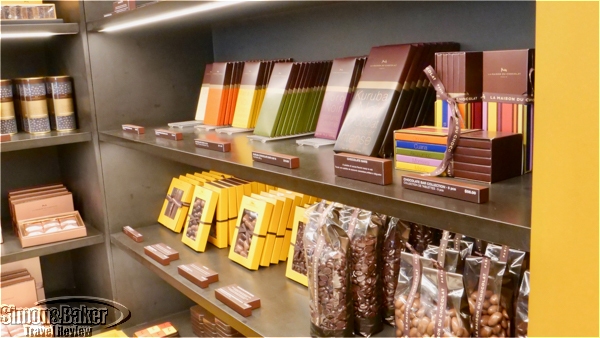
One of the display cases
Before Linxe passed away, he appointed his protégé, Nicolas Cloiseau, head chef. Today, Cloiseau oversees over thirty chefs. According to the staff, the chocolate on sale at the company shops was made in France following meticulous, traditional methods, and shipped to the various stores around the world.
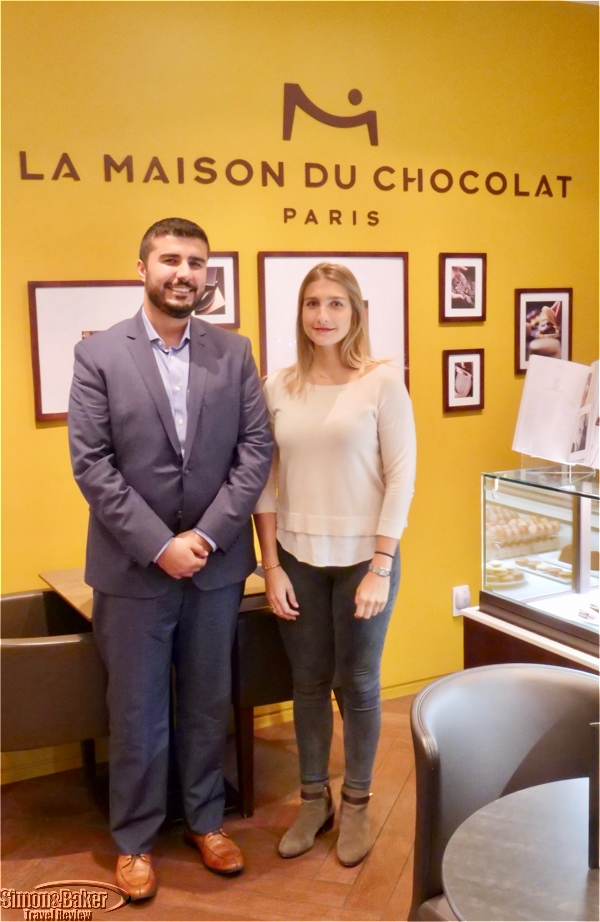
Rami Sarabi, country manager, and Eva Rousseaux, manager, Marketing
We were pleased to learn from Rami that all of the cocoa in the shop was from sustainable sources. The staff reported that they could trace each piece of chocolate back to the exact location from which the bean was harvested. We tasted three macaron flavors, Quito, Maracuja, and Rigoletto. Each macaron, we were told, was made in France and shipped to the various stores worldwide. The ones we sampled were not refrigerated. After a week on our shelf they remained fresh. The wafers were soft with a chewy texture, and melted on the tongue.
Quito was an airy and sweet milk chocolate wafer, a perfect compliment to the dark chocolate ganache. The passion fruit of the Maracuja macaron was tangy, its tropical tones highlighting the deeper notes of the ganache. The Rigoletto brought me back to a traditional flavor, with the middle-sweetness of caramel. In addition to being delicious, the macarons looked delightful lined up together.
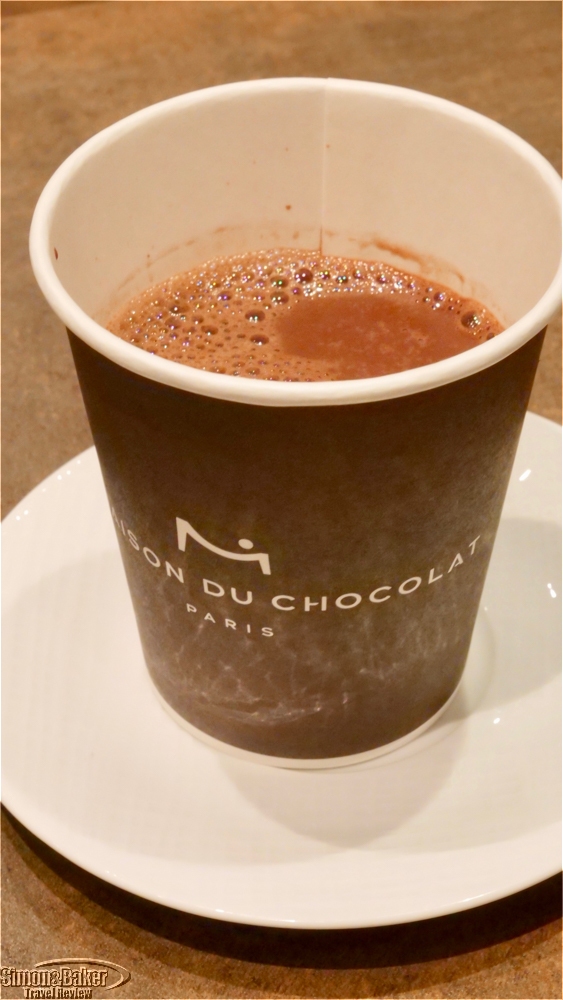
Our hot chocolate was served in disposable cups.
We loved the rich taste and high quality of the chocolates at La Maison du Chocolat, as well as the luxurious experience of the boutique itself. We plan to return to the shop, sit in the café, close our eyes, and be swept away by the complex flavors.